
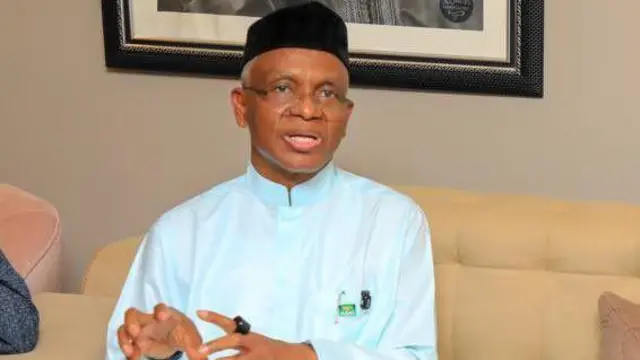
The high-profile trial of former Kaduna State Governor Nasir El-Rufai entered a new phase on Monday as a prosecution witness told a Federal High Court in Abuja that the former governor publicly acknowledged listening to conversations involving National Security Adviser Nuhu Ribadu.
The testimony came in a closely watched case that has raised serious questions about national security, cyber surveillance and the protection of sensitive government communications.
El-Rufai is facing charges brought by the Department of State Services (DSS) over allegations that he and others unlawfully intercepted communications linked to the NSA—an accusation he has denied.
The witness, Mr Deji Adeyanju, who testified for the Department of State Services (DSS), said he was present during an Arise News programme where El-Rufai allegedly made the statement that later became the basis of the criminal charges now before the court.
Adeyanju, who appeared as the second prosecution witness, told the court that he participated in an Arise News interview on February 16, the same day El-Rufai was featured on the station.
Led in evidence by prosecuting counsel, Oluwole Aladedoye, the witness stated that during the programme, El-Rufai said: “We listened to the conversations of the NSA, Mallam Nuhu Ribadu.”
According to Adeyanju, the remark drew attention because it suggested that conversations involving one of Nigeria’s most senior security officials had been accessed by unauthorised persons.
Court admits interview evidence
During Monday’s proceedings, the prosecution tendered the subpoena used to summon Adeyanju as a witness. The court admitted the document as evidence and marked it as Exhibit G.
The court also viewed the Arise News interview in open court.
In addition, prosecutors tendered a flash drive containing Adeyanju’s own television interview alongside a certificate of compliance. Both documents were admitted into evidence.
Adeyanju told the court that he was later invited by DSS investigators to provide details of what transpired during the television programme.
He said he informed investigators that El-Rufai had not only made the statement about listening to the NSA’s conversations but had also indicated during subsequent questioning that another individual allegedly carried out the interception and supplied him with the information obtained.
Defence challenges witness testimony
Under cross-examination by defence counsel, Chief Paul Erokoro (SAN), Adeyanju clarified that he did not hear El-Rufai expressly state that he personally hacked the NSA’s telephone lines.
However, he maintained that he distinctly heard the former governor say, “we listened to the conversations of the NSA.”
The defence also questioned him on whether he knew the communication devices used by the National Security Adviser and whether investigators had established which device was allegedly compromised.
Adeyanju responded that such matters were outside his knowledge and responsibility.
DSS charges against El-Rufai
The case stems from a three-count charge filed by the DSS against El-Rufai over alleged unlawful interception of communications linked to the National Security Adviser.
In the charge marked FHC/ABJ/CR/99/2026, the DSS accused the former governor of violating provisions of the Cybercrimes (Prohibition, Prevention, etc.) Amendment Act, 2024, as well as the Nigerian Communications Act, 2003.
According to the first count, El-Rufai allegedly admitted during an Arise TV interview on February 13, 2026, that he and others unlawfully intercepted the NSA’s communications.
The second count alleges that he knew the identity of a person who carried out the alleged interception but failed to report the individual to the appropriate authorities.
The third count accuses El-Rufai and others still at large of using technical systems or equipment to unlawfully intercept the NSA’s communications in a manner that allegedly threatened public safety and national security.
Trial continues
Justice Mohammed Umar adjourned proceedings until June 23, 2026, for continuation of trial.
The case is being closely watched because it touches on issues of national security, cybercrime enforcement and the limits of political disclosures involving sensitive intelligence matters.
If convicted, the charges could carry significant legal and political consequences for the former Kaduna governor, who remains one of Nigeria’s most influential opposition figures.
Beyond the fate of El-Rufai himself, the case is likely to test Nigeria’s cybercrime laws, the limits of political disclosures involving security matters and the ability of the state to protect the communications of its most senior officials.
Whatever the eventual verdict, the proceedings have already opened a rare public window into issues that are normally hidden behind the walls of Nigeria’s security establishment.
The Conscience Call
The allegations before the court strike at the heart of national security. If the unlawful interception of communications involving senior government officials occurred, it would raise serious questions about the integrity of Nigeria’s security architecture. Conversely, if such claims cannot be proven beyond reasonable doubt, the case will reinforce the importance of due process and the presumption of innocence. The judiciary now carries the responsibility of establishing the facts and ensuring that justice is guided by evidence rather than political sentiment.
Questions for the nation
- How secure are the communications of Nigeria’s top security officials?
- Should public admissions made during media interviews be sufficient grounds for criminal prosecution?
- What safeguards exist to prevent unlawful interception of private communications in Nigeria?
- How should the balance between national security and political accountability be maintained?
- What precedent could this case set for future cybercrime and surveillance prosecutions?
The Conscience Times
Nurturing a Conscience-Driven Society