

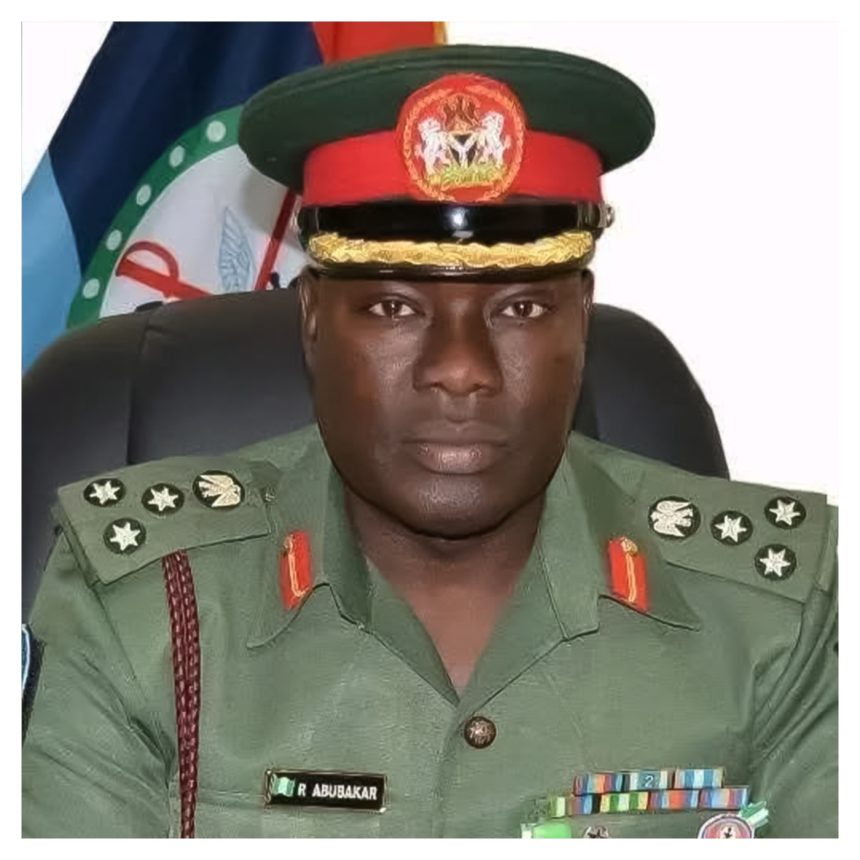
The death of retired Major General Rabe Abubakar in the custody of bandits should trouble every Nigerian.
Not merely because another citizen has fallen victim to the country’s worsening insecurity. Not merely because he was a former Director of Defence Information and a respected military officer. But because his death forces the nation to confront a deeply uncomfortable question:
If those who once defended Nigeria are no longer safe, what hope remains for the ordinary citizen?
For decades, military officers stood on the frontlines of Nigeria’s battles against insurgency, terrorism, banditry and organised crime. They commanded troops, formulated security strategies and risked their lives in defence of the nation.
Yet today, retired generals are being abducted on Nigerian roads. Senior military officers are increasingly becoming targets of the same criminal networks they once fought.
This should alarm us all.
A dangerous signal
Criminals are rational actors.
When bandits successfully abduct a retired general, hold him for days, negotiate demands and ultimately keep him in captivity until death, they are sending a message.
The message is not directed at the military alone.
It is directed at the entire nation.
It says that no one is beyond reach.
This shows that the state’s ability to protect its citizens is being openly challenged.
It says that criminal groups increasingly operate with a level of confidence that should concern every responsible leader.
For many years, insecurity was often viewed as a distant problem affecting villages, farmers and travellers in remote communities.
That illusion has collapsed.
The victims now include traditional rulers, religious leaders, academics, business executives, politicians and retired military officers.
The circle of vulnerability continues to widen.
The erosion of deterrence
Every successful kidnapping weakens deterrence.
Each attack that goes unpunished strengthens criminal confidence.
Every community abandoned to fear becomes fertile ground for further violence.
The purpose of law enforcement is not merely to react after crimes occur. Its most important function is deterrence.
Citizens must believe that the state can protect them.
Criminals must believe that the consequences of crime outweigh the rewards.
Today, too many Nigerians are beginning to doubt the first proposition, while too many criminals appear unconvinced by the second.
That is a dangerous combination.
A pattern we can no longer ignore
The death of Major General Rabe Abubakar (rtd) in bandits’ captivity did not occur in isolation.
In February 2025, former Director-General of the National Youth Service Corps, Major General Maharazu Tsiga (rtd), was abducted by bandits in Katsina State. He spent weeks in captivity before regaining his freedom.
Over the years, Nigeria has also witnessed the deaths of serving military commanders in operational theatres, including senior officers killed in terrorist attacks, ambushes and air incidents while leading troops against insurgents and criminal groups.
From the North-East to the North-West, military personnel have continued to pay the ultimate price in defence of the country.
Now, another retired general has died in captivity.
That should disturb the conscience of the nation.
Major General Rabe Abubakar was not an ordinary citizen. He was a former Director of Defence Information, a senior military officer who dedicated much of his life to serving and defending Nigeria.
If a man who once stood among the nation’s defenders can be abducted on a public road, held for weeks by criminals and ultimately die in captivity, then Nigerians must confront a painful reality: insecurity is becoming increasingly indiscriminate.
A national security emergency
The death of Major General Rabe Abubakar should not be treated as another headline that fades after a few news cycles.
It should be treated as a national wake-up call.
The reality is that Nigeria’s security challenge has evolved.
Banditry is no longer merely rural criminality.
Kidnapping is no longer an isolated crime.
Many criminal networks now possess sophisticated intelligence capabilities, communication systems, financial structures and operational reach.
Some groups monitor their targets, gather information and execute attacks with alarming precision.
This requires a response that is equally sophisticated.
The country cannot defeat twenty-first-century criminal networks with twentieth-century approaches.
What must be done urgently
First, intelligence must become the centrepiece of Nigeria’s security architecture.
The most successful security operations around the world are won through intelligence long before they are won through firepower.
Criminal networks should be identified, infiltrated and dismantled before attacks occur.
Second, technology must play a larger role in security operations.
Surveillance systems, digital intelligence, telecommunications monitoring and integrated databases should become standard tools rather than exceptions.
Third, Nigeria must strengthen coordination among security agencies.
Too often, information remains trapped within institutional silos while criminals move freely across state boundaries.
Bandits do not respect jurisdictional lines. Security responses should not be constrained by them.
Fourth, communities must become active security partners.
Residents are often the first to notice suspicious movements, unusual gatherings and emerging threats.
A security strategy that excludes local intelligence is incomplete.
Finally, government must restore public confidence.
Citizens need to see measurable progress.
They need to believe that those responsible for kidnappings, murders and acts of terror will be identified, arrested, prosecuted and punished.
Without accountability, fear flourishes.
One death too many
The tragedy of Rabe Abubakar’s death is not only that a retired general was kidnapped.
The tragedy is that Nigeria is gradually becoming accustomed to stories that should shock us.
Every life lost to banditry is a national failure.
Each citizen abducted represents a breach of the state’s fundamental responsibility.
Every victim who dies in captivity is one death too many.
Major General Rabe Abubakar’s death is one death too many.
The schoolchildren still held in captivity are too many.
The farmers murdered on their farms are too many.
The travellers abducted on highways are too many.
The soldiers killed in the line of duty are too many.
The communities displaced by violence are too many.
At some point, a nation must decide that enough is enough.
The larger question
The tragedy of Major General Rabe Abubakar is not ultimately about one man.
It is about the state of the nation.
When retired generals begin to fall victim to the same insecurity affecting farmers, traders, teachers and students, the distinction between the protected and the unprotected disappears.
A society cannot thrive when fear becomes democratised.
Economic growth becomes difficult.
Investment shrinks.
Communities become isolated.
Citizens lose confidence.
The social contract weakens.
The first duty of government is security.
Everything else rests upon it.
Nigeria’s democracy, economy and future prosperity ultimately depend on whether citizens can travel freely, sleep peacefully and live without constant fear of violence.
The death of a retired general in captivity should therefore not be seen merely as a personal tragedy.
It should be understood as a warning.
A warning that insecurity is becoming increasingly indiscriminate.
A warning that no social class, profession or status guarantees safety.
And a warning that the time for incremental responses may be running out.
The Conscience Conclusion
The defenders of a nation should not become easy prey for those who seek to destroy it.
If retired generals can be kidnapped, if senior officers can be ambushed, and if those who once commanded troops cannot travel safely on Nigerian roads, then the nation must urgently reassess its security strategy.
For when the defenders are no longer safe, the defended cannot be expected to feel secure.
The Conscience Times
Nurturing a Conscience-Driven Society