

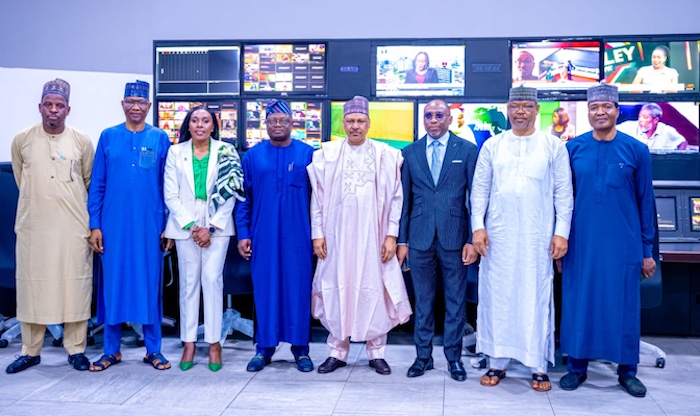
The Federal Government has officially launched FreeTV, a new digital television platform that will provide Nigerians with access to more than 100 television channels without monthly subscription fees.
The initiative, unveiled in Abuja on Wednesday alongside Nigeria’s Digital Switch Over (DSO) platform, is being presented as a major step in the country’s long-delayed transition from analogue to digital broadcasting.
Minister of Information and National Orientation, Mohammed Idris, who performed the launch at the headquarters of the Nigerian Communications Satellite Limited (NIGCOMSAT), said the platform is designed to expand access to information and entertainment while creating new opportunities across Nigeria’s media and creative industries.
What FreeTV offers
According to government officials, FreeTV will deliver a broad range of content including news, sports, movies, music, children’s programming, educational content and dedicated channels in Nigeria’s major languages, including Yoruba, Hausa and Igbo.
The platform will operate through a combination of satellite and terrestrial broadcasting networks, while a dedicated mobile application will also allow viewers to access content on digital devices.
Officials explained that households with compatible DVB-T2 or DVB-S2 decoders will not need to purchase new television sets to use the service. Existing free-to-air equipment may already support the platform.
Government sees economic benefits
Speaking at the launch, Idris described the Digital Switch Over programme as more than a broadcasting upgrade, arguing that it has the potential to stimulate economic activity across multiple sectors.
He said a fully implemented digital broadcasting ecosystem would create jobs, encourage local manufacturing, strengthen content production, expand advertising opportunities and generate new revenue streams for broadcasters and content creators.
“A fully implemented DSO ecosystem will create jobs, stimulate local manufacturing, expand audience reach, strengthen content production, increase advertising opportunities, and unlock new revenue streams for broadcasters and content creators,” the minister said.
He added that the project aligns with President Bola Tinubu’s Renewed Hope Agenda, which places emphasis on digital transformation, innovation and infrastructure development.
Nigeria adopts hybrid broadcasting model
The minister disclosed that extensive consultations were held with stakeholders across the broadcasting industry ahead of the launch, including broadcasters, signal distributors, content producers, manufacturers, advertising regulators and satellite operators.
According to him, the government has adopted a hybrid broadcasting model that combines Digital Terrestrial Television (DTT), satellite delivery and digital application-based platforms.
“Digital Terrestrial Television remains an integral component of Nigeria’s digital broadcasting framework. What we are pursuing is a hybrid broadcasting model that combines DTT, Direct-to-Home satellite delivery, and digital application-based platforms,” Idris said.
He also stressed that local participation would remain central to the project, promising support for indigenous manufacturers, Nigerian technology firms and local content creators.
NBC: FreeTV will expand access and create jobs
Director-General of the National Broadcasting Commission (NBC), Charles Ebuebu, described the platform as an important tool for widening access to quality television content while supporting Nigeria’s growing creative economy.
He said the service would allow millions of Nigerians to enjoy digital television without recurring subscription costs.
“With FreeTV, families across Nigeria can enjoy quality digital television without a monthly subscription, while our local content producers, technicians and young creatives gain new platforms and new jobs,” Ebuebu stated.
The NBC also announced plans to strengthen regional content production through studios located in Lagos, Abuja, Port Harcourt, Enugu, Kano and Benin.
The facilities are expected to support the work of producers, editors, camera operators, sound engineers and other professionals within the creative ecosystem.
Countdown to analogue switch-off
The launch comes as Nigeria continues preparations for the complete shutdown of analogue television broadcasting.
The NBC confirmed that the country’s final analogue switch-off remains scheduled for December 31, 2028, and encouraged Nigerians to check whether their decoders are compatible with the new platform.
Officials also urged viewers to download the FreeTV mobile application ahead of wider nationwide deployment.
For Nigeria’s broadcasting industry, the launch represents another attempt to fulfil a digital migration process that has experienced multiple delays over the years. For viewers, however, the immediate attraction is simpler: access to more television channels without the burden of monthly subscription payments.
Whether FreeTV succeeds in transforming television access nationwide will depend on its rollout, content quality, technical reliability and public adoption. But for now, the government is betting that subscription-free digital television could help usher in a new era of broadcasting in Africa’s most populous nation.
The Conscience Call
Access to information is a cornerstone of democracy, education and national development. If successfully implemented, FreeTV could help bridge information gaps, expand educational opportunities, deepen civic engagement and create fresh opportunities for Nigeria’s creative industry.
However, the success of the initiative will depend on more than the availability of channels. Millions of Nigerians still contend with epileptic power supply, making it difficult to enjoy consistent television services. In many rural and underserved communities, unreliable internet connectivity and poor telecommunications infrastructure also remain significant barriers to accessing digital platforms and mobile applications.
As Nigeria pushes towards a fully digital broadcasting future, policymakers must ensure that investments in media technology are matched by improvements in electricity, broadband penetration and digital infrastructure. Without these foundations, the benefits of digital broadcasting may remain unevenly distributed.
FreeTV is a promising step forward, but its long-term impact will depend on whether every Nigerian—not just those in major urban centres—can reliably access the service.
Questions for the Nation
- Can FreeTV provide a credible free alternative to paid television services in Nigeria?
- Will the platform improve access to educational and public-interest content in rural communities?
- How can local content creators maximise the opportunities created by the Digital Switch Over programme?
- Is Nigeria on track to meet its 2028 analogue switch-off deadline?
- What role should government play in expanding affordable access to digital media and information?
- How will millions of Nigerians benefit from digital television amid persistent power outages?
- Can the FreeTV mobile application achieve nationwide adoption without significant improvements in internet access and broadband coverage?
- Should digital infrastructure development be pursued alongside power sector reforms to maximise the benefits of Nigeria’s digital transition?
- What measures are needed to ensure rural communities are not left behind in the country’s digital broadcasting revolution?
- Beyond launching new platforms, how can government guarantee reliable access to the services being introduced?
The Conscience Times
Nurturing a Conscience-Driven Society