

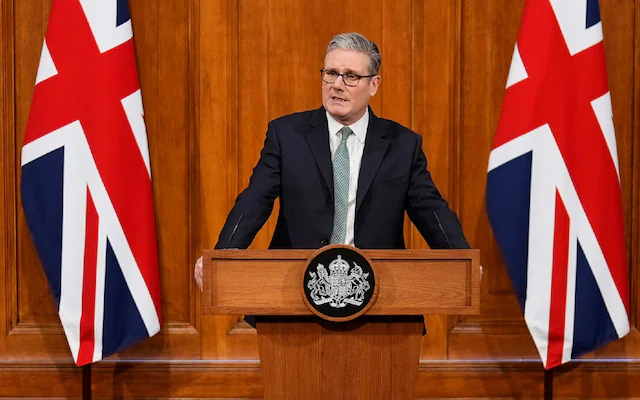
British Prime Minister Keir Starmer has announced his resignation, bringing a dramatic end to one of the most turbulent and shortest-lived premierships in modern British political history.
The announcement, made after months of growing unrest within the governing Labour Party, comes less than two years after Starmer led Labour to a historic landslide victory that ended 14 years of Conservative rule and appeared to herald a new political era in the United Kingdom.
Instead, his departure now leaves Britain searching for yet another leader and raises fresh questions about the stability of one of the world’s oldest democracies.
What happened?
In an emotional statement, Starmer acknowledged that he no longer enjoyed sufficient support within Labour to lead the party into the next general election and said he would step aside to allow an orderly transition. He is expected to remain as caretaker prime minister until a successor is formally chosen.
His resignation follows months of mounting pressure from Labour MPs, worsening poll numbers and growing concerns that the party was losing ground to Nigel Farage’s Reform UK movement.
The immediate beneficiary appears to be former Greater Manchester Mayor Andy Burnham, who has rapidly emerged as the overwhelming favourite to succeed Starmer. Several influential Labour figures have already lined up behind him.
From landslide victory to political crisis
The speed of Starmer’s downfall is remarkable.
When Labour swept to power in the 2024 general election, many political observers believed Britain had finally emerged from years of Brexit divisions, Conservative infighting and economic instability.
Starmer’s reputation as a disciplined former prosecutor helped convince voters that Labour could provide competence and stability after years of political turbulence.
Yet governing proved far more difficult than campaigning.
His administration struggled to generate the economic recovery many voters expected. Living costs remained a major concern, public dissatisfaction persisted and Labour’s popularity steadily eroded.
By 2026, local election results exposed the depth of Labour’s troubles. The party suffered significant losses, triggering open rebellion among MPs and accelerating calls for a leadership change.
The issues that haunted Starmer
Political analysts point to several factors behind the collapse of Starmer’s authority.
First was the economy.
Although Labour inherited serious economic challenges, many voters felt improvements had not arrived quickly enough. High living costs and concerns about growth increasingly dominated public debate.
Second was immigration.
The issue remained politically potent across Britain, allowing Reform UK and Nigel Farage to attract disillusioned voters who believed mainstream parties were failing to address border concerns.
Third was a series of political controversies that damaged confidence in Starmer’s judgment.
Among the most damaging was controversy surrounding the appointment of Peter Mandelson, a saga that fuelled criticism within Labour and contributed to wider questions about the Prime Minister’s leadership.
Combined with poor polling and growing dissatisfaction among Labour MPs, these issues gradually eroded the authority that had carried him into office.
The rise of Andy Burnham
Starmer’s resignation has immediately shifted attention to Andy Burnham.
The former Greater Manchester mayor has long been viewed as one of Labour’s strongest political communicators and has cultivated an image as a politician more closely connected to working-class voters than many figures in Westminster.
His recent parliamentary victory significantly strengthened his position and convinced many Labour MPs that he offered the party its best chance of revival.
Whether Burnham can reunite Labour and restore public confidence remains an open question.
What does this mean for Britain?
Starmer’s resignation means Britain is set to have its seventh prime minister in roughly a decade, a statistic that would have seemed unthinkable in an era when British governments were considered among the most stable in the world.
The development reflects a deeper trend that extends beyond one leader or one party.
Across many Western democracies, voters are becoming increasingly impatient with traditional political establishments. Economic anxieties, immigration debates, cultural divisions and declining trust in institutions have created a volatile political environment where governments can rise and fall with remarkable speed.
Britain’s experience mirrors wider trends visible across Europe and North America, where established parties are facing growing challenges from insurgent political movements.
Lessons for Democracies
For observers around the world, Starmer’s resignation offers an important reminder that electoral victory alone does not guarantee political survival.
Winning power is one challenge.
Maintaining public confidence while governing through economic pressures, security concerns and shifting political expectations is another entirely.
Starmer succeeded where many thought Labour would fail: he defeated the Conservatives and returned his party to government.
His inability to convert that victory into enduring political support may ultimately define his premiership.
The Conscience Analysis
Keir Starmer’s fall is not merely the story of a prime minister who lost his job.
It is the story of a political age in which voters are increasingly unwilling to grant governments long periods of grace.
Across democracies, electorates are demanding quicker results, stronger leadership and tangible improvements in everyday life. When those expectations are not met, political fortunes can change with startling speed.
For Britain, the question is whether Andy Burnham can succeed where Starmer faltered.
For the wider democratic world, the deeper question is whether traditional political parties can still adapt fast enough to satisfy increasingly impatient electorates.
The answer may shape not only Britain’s future but the future of democratic politics itself.