


Lagos, Nigeria – June 5, 2026
- Market Loses Nearly ₦5 Trillion
- Financial Stocks Dominate Trading
- More Stocks Decline Than Advance
- International Energy Insurance Emerges Top Gainer
- First HoldCo, BUA Cement Among Major Losers
- Bond Market Records Massive Jump
- New FGN Savings Bonds Listed
- Fidson Healthcare Expands Share Capital
- What It Means for Investors
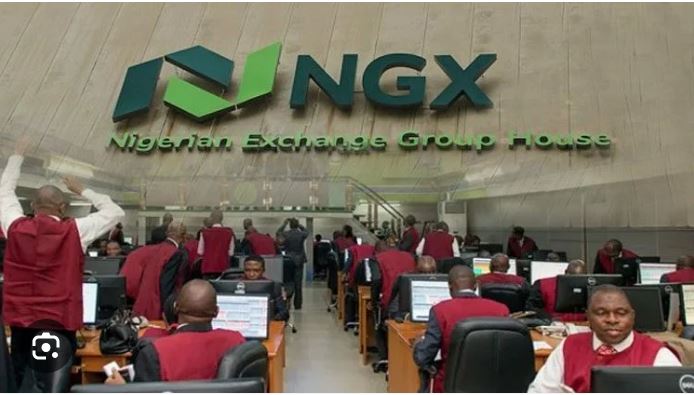
Trading activity on the Nigerian Exchange Limited (NGX) surged significantly during the week ended June 5, 2026, even as the stock market recorded a sharp decline that wiped trillions of naira from investors’ portfolios.
According to the latest NGX Weekly Report, investors traded a total of 3.97 billion shares valued at ₦175.66 billion in 343,587 deals during the week, representing a substantial increase from the 2.40 billion shares worth ₦111.48 billion traded in the previous week.
The figures indicate growing market participation despite a broader bearish sentiment that saw key market indicators close lower.
Market Loses Nearly ₦5 Trillion
The NGX All-Share Index (ASI), the benchmark indicator of market performance, fell by 3.11 per cent to close the week at 242,593.31 points from 250,385.47 points recorded the previous week.
Similarly, market capitalisation declined by 3.06 per cent to ₦155.59 trillion.
The decline translates to an estimated ₦4.9 trillion loss in market value within five trading sessions, underscoring renewed profit-taking activities and investor caution across several sectors of the market.
Market analysts say the downturn reflects a combination of portfolio rebalancing, profit-taking by investors after months of sustained gains, and reactions to prevailing macroeconomic conditions.
Financial Stocks Dominate Trading
The Financial Services sector remained the most active segment of the market during the week.
The sector accounted for 2.69 billion shares valued at ₦69.98 billion traded in 134,882 deals, contributing nearly 68 per cent of total trading volume.
The Services sector followed with 323.60 million shares worth ₦6.44 billion, while the Information and Communications Technology (ICT) sector recorded 176.04 million shares valued at ₦27.89 billion.
Three companies—Access Holdings Plc, Abbey Mortgage Bank Plc and Sterling Financial Holdings Company Plc—accounted for more than one-third of total market volume, jointly recording 1.29 billion shares worth ₦17.56 billion.
More Stocks Decline Than Advance
Investor sentiment remained largely negative during the week as declining stocks significantly outnumbered gainers.
A total of 65 listed equities recorded price losses, compared to 23 stocks that posted gains, while 58 equities closed unchanged.
This compares unfavourably with the previous week when 34 stocks appreciated and 51 declined.
The trend suggests increased selling pressure across multiple sectors of the market.
International Energy Insurance Emerges Top Gainer
Among the week’s best-performing stocks was International Energy Insurance Plc, which gained 60.62 per cent to close at ₦7.26 per share.
Abbey Mortgage Bank Plc followed with a 47.24 per cent appreciation, while Tripple Gee and Company Plc rose by 9.80 per cent.
Other notable gainers included:
- Ikeja Hotel Plc (+9.45%)
- RT Briscoe Plc (+8.86%)
- Consolidated Hallmark Holdings Plc (+7.20%)
- Access Holdings Plc (+3.95%)
- Neimeth International Pharmaceuticals Plc (+3.92%)
The strong performance of these stocks helped cushion broader market losses for some investors.
First HoldCo, BUA Cement Among Major Losers
On the losing side, Associated Bus Company Plc recorded the steepest decline, shedding 24.73 per cent of its value.
Other major losers included:
- University Press Plc (-17.07%)
- Eterna Plc (-12.92%)
- John Holt Plc (-12.09%)
- First HoldCo Plc (-11.43%)
- Wema Bank Plc (-10.45%)
- BUA Cement Plc (-10.00%)
The declines among several large-cap and banking stocks contributed significantly to the overall market downturn.
Bond Market Records Massive Jump
While the equities market struggled, activity in the bond market surged dramatically.
Investors traded 49.52 million bond units worth ₦52.91 billion during the week, compared to just ₦157 million recorded in the previous week.
The sharp increase was largely driven by transactions involving the NBET2033S1B bond, which accounted for the overwhelming majority of bond market value traded.
The development suggests continued investor appetite for relatively safer fixed-income assets amid market volatility.
New FGN Savings Bonds Listed
The NGX also announced the listing of new Federal Government Savings Bonds issued in May 2026.
The instruments include:
- 13.525% FGS May 2028 Bond valued at ₦884.86 million
- 14.525% FGS May 2029 Bond valued at ₦3.19 billion
The listings provide additional investment options for retail investors seeking government-backed securities.
Fidson Healthcare Expands Share Capital
In another notable development, Fidson Healthcare Plc listed an additional 600 million ordinary shares on the Exchange following the successful completion of its rights issue.
The listing increased the company’s total issued shares from 2.4 billion to 3.0 billion ordinary shares.
The move is expected to strengthen the pharmaceutical company’s capital base and support future growth initiatives.
What It Means for Investors
Despite the week’s decline, the Nigerian stock market remains significantly positive on a year-to-date basis, with the NGX All-Share Index still posting a gain of 55.9 per cent since the beginning of the year.
Analysts note that the recent pullback may represent a period of market correction following strong gains recorded in previous months.
However, the sharp increase in trading activity suggests that investors remain actively engaged and continue to reposition their portfolios in response to evolving market conditions.
For policymakers and market participants, the challenge remains sustaining investor confidence while navigating broader economic realities, including inflation, interest rates, and currency stability.
As the second half of the year gathers momentum, market watchers will be keenly observing whether the recent decline marks a temporary correction or the beginning of a broader adjustment in Nigeria’s capital market.
The Conscience Times
Nurturing a Conscience-Driven Society