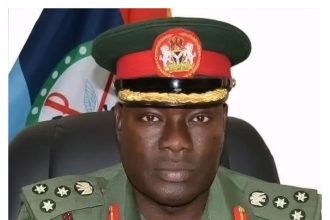



A Federal High Court in Abuja has sentenced the mother and sister of slain terrorist leader Kachallah Ibrahim Battujo to 40 years imprisonment each for aiding and concealing his terrorist activities.
Justice Hauwa Yilwa delivered the judgment on Friday after both women, Safiya Salihu and Halima Abdullahi, pleaded guilty to multiple terrorism-related offences brought against them by the Office of the Attorney General of the Federation.
The conviction marks one of the most significant prosecutions targeting relatives and civilian collaborators of a notorious terrorist figure, underscoring the authorities’ growing determination to dismantle support networks that sustain violent criminal groups across northern Nigeria.
Convicted for aiding terrorist operations
According to court documents, the two women were found guilty on three counts bordering on aiding and abetting terrorism, passing intelligence to a known terrorist, and concealing information capable of leading to his arrest.
Prosecutors told the court that both defendants maintained telephone communications with Battujo and provided information that assisted his operations.
Safiya, the terrorist kingpin’s mother, was further convicted for withholding critical information after visiting her son’s hideout and observing him in possession of firearms.
Halima, Battujo’s sister, was found guilty of concealing information that could have helped security agencies apprehend the wanted terrorist leader.
The charges were brought under provisions of the Terrorism (Prevention and Prohibition) Act, 2022.
Court dismisses terrorism proceeds charge
While the prosecution initially accused the women of receiving ₦490,300 believed to be proceeds of terrorism, the Federal High Court discharged them on that count following an application by the Director of Public Prosecutions of the Federation, Mohammed Abubakar Oyedepo (SAN).
The court, however, sustained the remaining counts and entered convictions based on the defendants’ guilty pleas.
Although each count carried a potential 20-year jail term, Justice Yilwa ordered that the sentences run concurrently, resulting in an effective prison term of 40 years each.
The court also directed that both convicts undergo rehabilitation after serving their sentences.
Battujo killed during failed abduction operation
The convictions come barely weeks after Battujo himself was killed by security forces on June 10, 2026.
The terrorist commander met his end following a failed attempt to carry out a mass abduction and attack on students writing the West African Senior School Certificate Examination (WASSCE) near Iluke in Kabba/Bunu Local Government Area of Kogi State.
His death was widely celebrated by security agencies and local communities that had endured years of attacks linked to his network.
Targeting terror support networks
Security experts have repeatedly argued that terrorist and bandit leaders survive not only because of armed fighters but also because of extensive civilian support systems that provide intelligence, logistics, communication channels, food supplies, financial assistance and safe havens.
Friday’s judgment is therefore being viewed as a significant signal that authorities are increasingly focusing on individuals who enable terrorist operations, whether directly or indirectly.
The case also highlights the Federal Government’s broader efforts to strengthen the enforcement of Nigeria’s anti-terrorism laws amid continuing security challenges across parts of the country.
With the conviction of Battujo’s closest family members, authorities say the message is clear: anyone found aiding, shielding or facilitating terrorist activities will face the full weight of the law, regardless of family ties.
The Conscience Call
The conviction of the mother and sister of slain terrorist kingpin Kachallah Ibrahim Battujo raises uncomfortable but necessary questions about the ecosystem that sustains terrorism in Nigeria.
For years, security conversations have focused almost exclusively on the men carrying guns in forests and remote communities. Yet terrorist organisations rarely survive on firepower alone. They depend on intelligence networks, logistics suppliers, informants, financiers, couriers, recruiters and sympathisers.
The lesson from this case is that defeating terrorism requires dismantling the entire support structure around violent groups. Security agencies must continue to target not only the perpetrators of violence but also those who knowingly aid, shield or facilitate their activities.
At the same time, the rule of law must remain paramount. Every accused person must be prosecuted based on evidence and due process, not merely on association or family ties.
Nigeria cannot win the war against terrorism unless both justice and accountability reach every layer of the criminal network.
Questions for the Nation
- How many terrorist and bandit networks continue to receive support from civilian collaborators?
- Are security agencies doing enough to identify and dismantle logistical support systems for terrorists?
- Should penalties for aiding and abetting terrorism be strengthened further?
- How can communities be encouraged to report relatives and associates involved in terrorism without fear of retaliation?
- Beyond military action, what social and economic measures are needed to prevent communities from becoming recruitment grounds for terrorist groups?
The Conscience Times
Nurturing a Conscience-Driven Society