

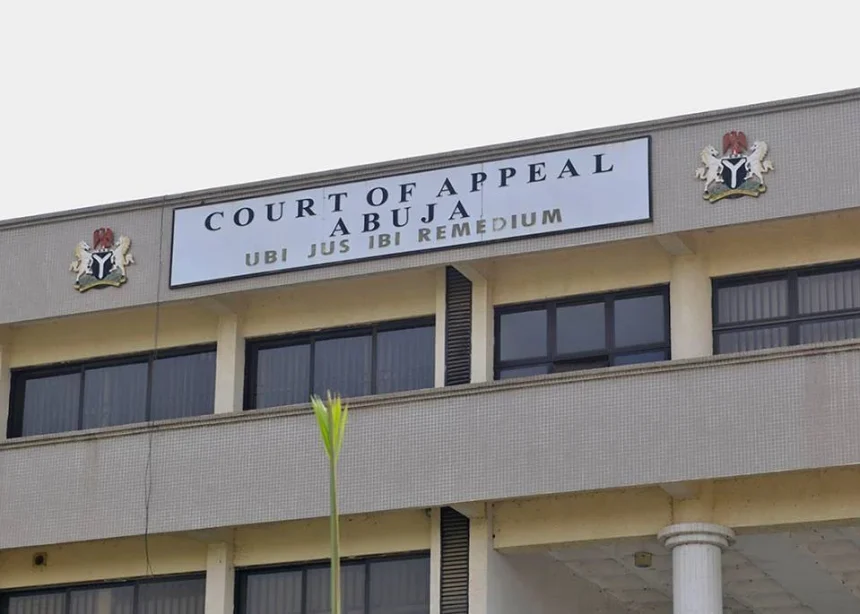
The Court of Appeal has halted the deregistration of the African Democratic Congress (ADC) and four other political parties, delivering a major reprieve to opposition groups and opening a fresh chapter in what is rapidly becoming one of the most consequential legal battles ahead of the 2027 general elections.
In a unanimous ruling delivered in Abuja on Tuesday, a three-member panel led by Justice A.B. Mohammed ordered a stay of execution of the Federal High Court judgment that directed the Independent National Electoral Commission (INEC) to deregister the ADC, Accord Party, Action Alliance (AA), Action Peoples Party (APP), and Zenith Labour Party (ZLP).
Beyond suspending the judgment, the appellate court issued a scathing rebuke of the trial judge, Justice Peter Lifu, accusing him of proceeding with the matter despite an earlier order directing him to halt further action pending the determination of an appeal.
Court condemns lower court’s conduct
The appellate panel described the trial court’s decision to proceed with the judgment as a direct affront to the judicial hierarchy and constitutional order.
According to the court, the lower court’s action amounted to a violation of an existing appellate order issued on May 22, which had expressly stayed further proceedings in the case.
In unusually strong language, the Court of Appeal characterised the conduct as a “brazen violation” of judicial authority and cited Supreme Court precedents that regard such actions as incompatible with the standards expected of judicial officers.
The court stressed that preserving the integrity of the judicial system required strict obedience to the hierarchy of courts and ruled that the judgment would remain suspended pending the determination of substantive appeals.
Opposition parties retain legal status
The ruling means that all five affected parties remain legally recognised political parties and can continue participating in electoral activities pending the final resolution of the matter.
The decision is particularly significant because several electoral activities are already underway in different parts of the country, including preparations for forthcoming elections and by-elections.
Had the judgment remained in force, it could have triggered widespread political and electoral uncertainty, especially for candidates who had emerged on the platforms of the affected parties.
INEC distances itself from judgment
One of the most striking moments during the proceedings came when INEC disclosed that it was unaware the Federal High Court had gone ahead to deliver judgment.
Represented by its lead counsel, Haliru Mohammed, the electoral commission told the appellate court that it only became aware of the judgment through media reports.
INEC further indicated that it did not oppose the application seeking a stay of execution and aligned itself with the appeals filed by the affected political parties.
The commission’s position reinforced arguments by opposition parties that the circumstances surrounding the judgment raised serious procedural questions.
WhatsApp notification claim sparks reactions
The proceedings also produced another dramatic revelation.
Counsel to the ADC, Shuaibu Aruwa (SAN), informed the appellate court that notification regarding the delivery of the Federal High Court judgment was communicated to the party through WhatsApp.
The disclosure reportedly drew strong reactions from members of the appellate panel.
Aruwa argued that the circumstances surrounding the judgment justified urgent intervention by the Court of Appeal, warning that allowing the ruling to stand could undermine public confidence in the judiciary and create unnecessary political instability.
Why the case matters
The dispute extends beyond the fate of five political parties.
At the heart of the controversy lies a broader debate over the future of Nigeria’s multiparty democracy, the powers of INEC regarding party registration, and the extent to which courts can intervene in determining the continued existence of political parties.
Opposition leaders, including former Vice President Atiku Abubakar, former Senate President David Mark, and Osun State Governor Ademola Adeleke, had earlier warned that the deregistration order could significantly narrow Nigeria’s democratic space ahead of the 2027 elections.
Supporters of the affected parties also argued that the judgment risked disenfranchising millions of voters who identify with alternative political platforms outside the major parties.
Battle shifts to substantive appeal
While Tuesday’s ruling represents an important victory for the ADC and the other affected parties, the legal battle is far from over.
The Court of Appeal has only suspended the enforcement of the judgment pending the determination of the substantive appeals.
The final outcome will ultimately determine whether the Federal High Court was correct in ordering deregistration and whether the constitutional provisions governing political parties were properly interpreted.
For now, however, the ruling restores the status quo and ensures that the ADC, Accord Party, Action Alliance, Action Peoples Party and Zenith Labour Party remain active participants in Nigeria’s political landscape.
The bigger picture
The decision is likely to be viewed as a major boost for opposition parties at a time when concerns about democratic competition and political pluralism are increasingly shaping conversations ahead of 2027.
With the appellate court’s intervention, what began as a legal challenge over party registration has evolved into a broader test of judicial authority, electoral fairness and the resilience of Nigeria’s multiparty democratic system.
As the substantive appeals proceed, the outcome could shape not only the future of the affected parties but also the rules governing political competition in the run-up to the next general election.
The Conscience Call
Democracy thrives when voters—not courtrooms, political actors or institutions—determine which parties survive. While political parties must meet constitutional obligations, any process that appears to narrow democratic choices ahead of a major election cycle will inevitably attract scrutiny. The appellate court’s intervention underscores a fundamental principle: the rule of law must be followed by all, including the courts themselves.
Questions for the Nation
- Should political parties be deregistered solely on the basis of electoral performance?
- Did the Federal High Court overstep by proceeding despite a pending appellate order?
- What safeguards are needed to protect Nigeria’s multiparty democracy ahead of 2027?
- Could the controversy affect public confidence in the judiciary and electoral process?
- How can electoral reforms balance accountability for political parties with democratic inclusiveness?
The Conscience Times
Nurturing a Conscience-Driven Society