

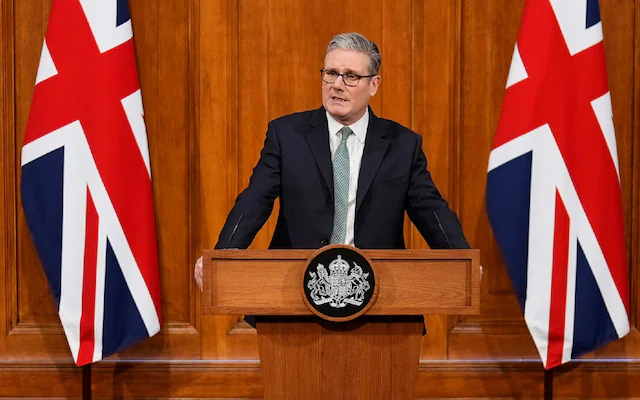
The United Kingdom’s decision to ban children under the age of 16 from major social media platforms is more than a domestic policy announcement. It is a declaration that one of the world’s oldest democracies believes the age of unrestricted childhood access to social media must come to an end.
If implemented as planned in 2027, the policy will fundamentally alter how millions of British children interact with the digital world. It will also place the UK at the centre of a growing global debate over whether social media has become too powerful, too addictive and too dangerous to remain accessible to children without meaningful restrictions.
The move raises profound questions for governments, technology companies, parents and young people themselves.
Has society reached a tipping point in its relationship with social media? And could Britain be leading the beginning of a global reset?
Why Britain is taking action
The UK government’s justification is straightforward: too many children are being exposed to harmful online experiences.
The decision follows a nationwide consultation that revealed overwhelming public support for stronger protections. According to the government, nine out of ten parents backed a social media ban for under-16s, while a significant proportion of young people themselves agreed that certain platforms should be inaccessible to younger users.
Those figures reflect growing unease over years of research linking excessive social media use to anxiety, depression, sleep deprivation, cyberbullying, body-image issues and declining attention spans among young people.
For policymakers, the question is no longer whether social media can be harmful. The debate has shifted to how much harm society is willing to tolerate before intervention becomes necessary.
What exactly is being banned?
The proposal targets mainstream social media platforms such as Instagram, TikTok, Snapchat, Facebook, X and YouTube.
Children under 16 would no longer be permitted to hold accounts on these platforms.
The government has deliberately distinguished social media from messaging services. Applications such as WhatsApp and Signal are expected to remain accessible because they are primarily used for communication with known contacts rather than public content consumption.
That distinction reveals an important element of the policy.
The UK is not attempting to disconnect children from the internet. Instead, it is trying to limit exposure to algorithm-driven platforms designed to maximise engagement and screen time.
Officials insist children will still have access to educational resources, online news, gaming services and communication tools.
The target is not the internet itself. The target is a specific type of digital experience.
The hidden danger of platform design
What makes the UK’s approach noteworthy is its focus not only on platforms but also on features.
Authorities have identified livestreaming and unrestricted communication with strangers as particularly high-risk activities.
As a result, these functions will be restricted for younger users across other online services, including gaming platforms.
For teenagers aged 16 and 17, livestreaming and stranger contact will be disabled by default.
This reflects a growing understanding among regulators that online harm is often created not merely by content but by design.
Features that encourage constant interaction, viral attention and direct access to vulnerable users have become central concerns for child safety advocates.
The UK appears to be moving beyond content moderation towards regulating the architecture of digital platforms themselves.
Can the ban actually work?
This is perhaps the biggest question.
Previous attempts around the world to restrict children’s access to online platforms have encountered significant obstacles.
Young people are often technologically savvy. Many already circumvent age restrictions by entering false birth dates or using alternative accounts.
The British government believes stronger age verification requirements can address this challenge.
Adults may be required to prove their age through methods ranging from credit card verification to facial age estimation technology. Ofcom is expected to develop detailed standards in the coming months.
However, privacy advocates have already raised concerns.
The more rigorous age verification becomes, the more personal data platforms may need to collect. Critics argue that efforts to protect children must not create new risks relating to surveillance and data security.
This tension between safety and privacy may become one of the defining policy debates of the digital age.
Why technology companies are worried
For social media companies, children and teenagers represent a critical segment of their user base.
The younger a user joins a platform, the longer that company can potentially retain them as a customer.
Removing millions of under-16 users from social media platforms could affect advertising revenues, user growth and long-term engagement metrics.
More importantly, Britain’s decision may create momentum for similar measures elsewhere.
If the policy proves successful, governments across Europe, North America, Africa and Asia could face pressure to adopt comparable restrictions.
Technology firms understand that what begins in one country can quickly become a global regulatory trend.
What does this mean for Nigeria?
Although Nigeria has not proposed a similar ban, the issues driving Britain’s decision are not unique to the UK.
Nigerian parents face many of the same concerns: cyberbullying, online fraud, exposure to inappropriate content, digital addiction and declining attention spans among children.
The difference lies largely in enforcement capacity and regulatory priorities.
Implementing such a policy would require reliable age-verification systems, strong regulatory institutions and cooperation from technology companies.
Yet the broader debate is one Nigeria cannot ignore.
As smartphone penetration increases and children gain internet access at younger ages, questions about digital wellbeing will become increasingly urgent.
The UK’s decision may therefore serve as a useful case study for policymakers across Africa.
A global experiment
Ultimately, Britain’s social media ban is an experiment.
Supporters see it as a necessary intervention to protect childhood from technologies designed to capture attention and maximise engagement.
Critics view it as government overreach that may prove difficult to enforce and potentially infringe on personal freedoms.
Both sides agree on one thing: the outcome matters.
If the policy succeeds, it could become a blueprint for countries around the world.
If it fails, governments may need to search for alternative ways to protect children in an increasingly digital society.
Either way, the UK has forced a conversation that many nations have been reluctant to have.
The question is no longer whether social media affects children.
The question is whether society is prepared to redraw the boundaries between childhood and the digital world.
The Conscience Call
For years, governments largely treated social media as a matter of personal responsibility. Britain’s decision suggests that era may be ending.
Children have always required special protections in the physical world. The challenge of our time is determining whether the same principle should apply online.
The answer will shape not only the future of technology regulation but also the future of childhood itself.
Questions for the Nation
- Should Nigeria consider age restrictions on social media platforms?
- Are parents or governments better positioned to regulate children’s online activities?
- Can age-verification systems be effective without compromising privacy?
- Do social media companies bear responsibility for the mental wellbeing of young users?
- Has the digital age fundamentally changed what childhood means?
The Conscience Times
Nurturing a Conscience-Driven Society