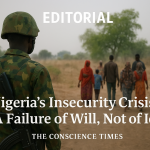



Nigeria is not short of security blueprints. What the country lacks, and dangerously so, is the political will, institutional discipline and moral urgency to implement them.
From the forests of the North-West to the highways of the South-East, from the farmlands of the Middle Belt to coastal communities in the South-South, insecurity has become the most defining feature of Nigerian life. Banditry, kidnapping-for-ransom, insurgency, communal violence and organised criminality now coexist in a toxic web that has normalised fear and cheapened human life.
This is no longer a collection of isolated incidents. It is a national emergency.
Yet, year after year, Nigeria responds to mass killings and abductions with the same tired rituals: official condemnations, security meetings, vague promises and the inevitable silence that follows until the next tragedy strikes.
A State That Has Lost Its Deterrent Power
At the heart of Nigeria’s insecurity is the erosion of state authority. Criminal groups now operate with audacity because they no longer fear consequences. Villages are attacked repeatedly. Ransoms are negotiated openly. Known perpetrators roam free while victims are buried and forgotten.
This collapse of deterrence is worsened by a criminal justice system that is slow, opaque and, in some cases, compromised. Arrests are rarely followed by prosecutions. Convictions are rarer still. Insecurity thrives where impunity is the norm.
Security is not only about firepower; it is about certainty — certainty that crime will be punished, swiftly and decisively.
Overcentralisation and the Policing Gap
Nigeria’s security architecture remains dangerously overcentralised for a country of its size, complexity and diversity. A single federal police force is expected to secure over 200 million people across vastly different terrains and threat profiles. This is neither practical nor sustainable.
Local intelligence is routinely ignored. Community trust in security agencies is thin, eroded by years of abuse, extortion and poor response times. Citizens who do not trust the state will not cooperate with it, and without cooperation, no security strategy can succeed.
The debate over state and community policing can no longer be treated as a political taboo. It is a practical necessity.
The Political Economy of Violence
Nigeria must also confront an uncomfortable truth: insecurity has become profitable for some. From ransom networks and arms traffickers to shadowy political actors who weaponise violence for leverage, there are vested interests in chaos.
Poverty, youth unemployment and the collapse of rural economies continue to supply a steady stream of recruits to criminal networks. But socio-economic hardship alone does not explain the scale of Nigeria’s violence. Where leadership fails to act decisively, criminality fills the vacuum.
Leadership Beyond Statements
The measure of leadership in moments like this is not rhetoric but results. Nigerians do not need more sympathy visits or condolence messages. They need visible accountability, clear timelines and measurable outcomes.
Security agencies must be properly funded, trained and coordinated. But they must also be held accountable. The era of security budgets without security outcomes must end.
Equally, political leaders must stop treating insecurity as a regional or partisan talking point. A child abducted in Kaduna, a farmer killed in Benue, a commuter kidnapped in Kwara, or a trader shot in Imo is not someone else’s problem; it is Nigeria’s problem.
The Conscience Question
At its core, insecurity is a moral issue. A state that cannot protect its citizens has breached its most basic social contract. When lives are lost daily and justice is delayed indefinitely, the nation’s conscience must be stirred.
Nigeria must decide what kind of country it wants to be: one where citizens adapt to fear, or one where leadership confronts evil with clarity, courage and consistency.
The cost of inaction is already unbearable. The cost of continued indifference will be fatal.
— The Conscience Times Editorial Board